Marriage Preparation Doesn't Start with a short-term Course — It Starts in the Nursery
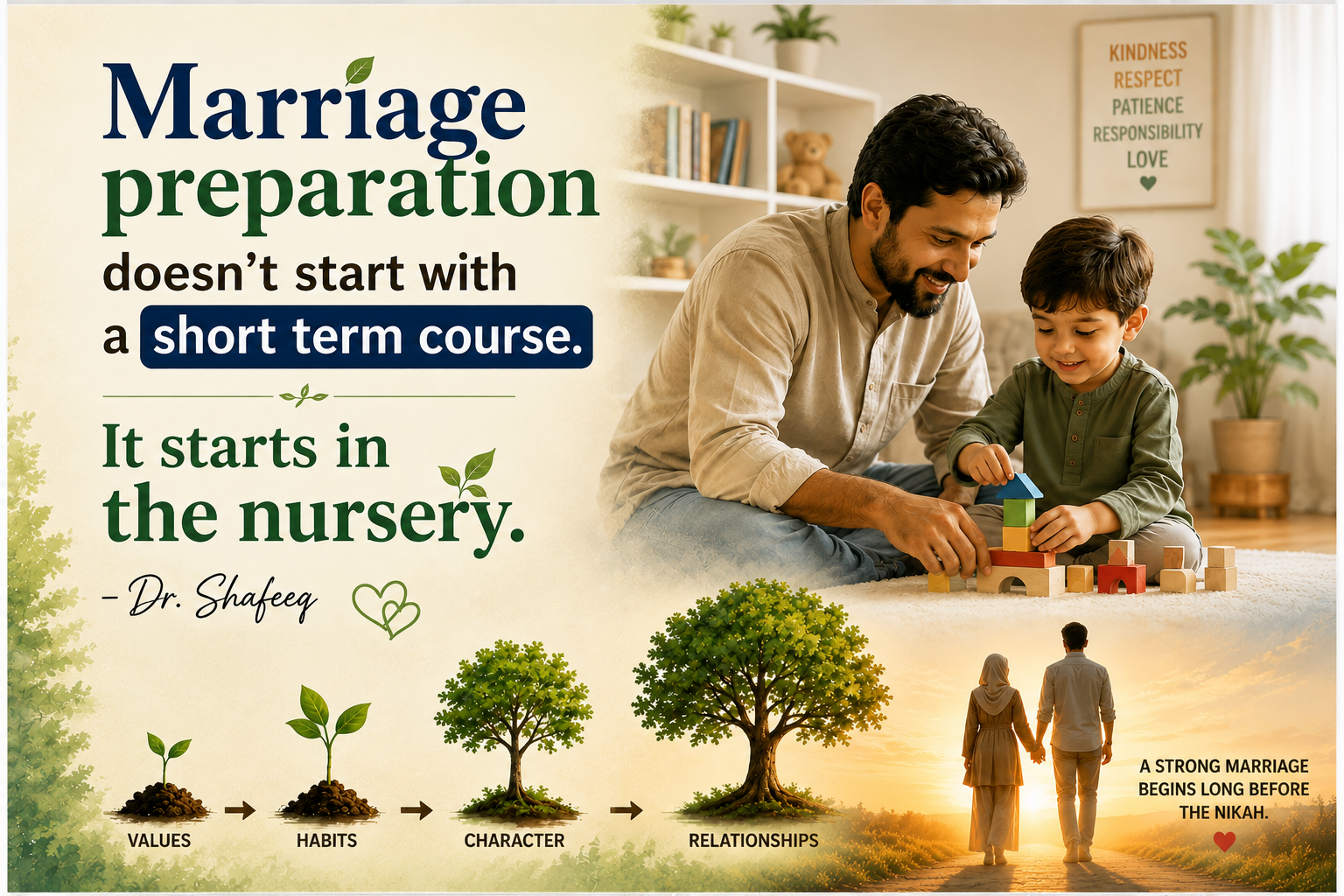
Marriage Preparation Doesn't Start With a Course — It Starts in the Nursery
Dr. Shafeeq Ahmed
Ask an engaged couple when their marriage preparation began, and most will name a date somewhere in the six months before the wedding: a weekend retreat, a handful of sessions with a counsellor, a course run because the venue required a certificate. Ask them a different question — when did you learn to trust someone with something that could be used against you, or keep a promise when it was inconvenient, or tolerate not getting your way without punishing the other person for it — and the answer is much earlier, much less deliberate, and rarely connected in their minds to marriage at all.
That gap is the problem. Premarital counselling, as it's conventionally practiced, arrives too late to do the work it's asked to do. It tries, in a handful of sessions, to install capacities that are properly the product of two decades of development — emotional regulation, the ability to read another person accurately, the willingness to be accountable for your own conduct. Those aren't skills you hand someone in a weekend, however well the weekend is designed. They're dispositions built slowly, through thousands of small encounters with parents, siblings, friends, teachers, and colleagues, long before any wedding is on the calendar.
If that's true, the real question isn't "how do we make premarital counselling better." It's "who is actually doing marriage education, years before anyone would call it that?" The honest answer is: parents, schools, and workplaces — usually without knowing that's what they're doing.
Parents: the first and most powerful classroom
A child who grows up watching their parents repair a disagreement — rather than avoid it or let it curdle into contempt — has, by the age of ten, already absorbed more about how to sustain a marriage than any course will later teach them. Decades of research on married couples has found that what predicts whether a marriage survives isn't whether conflict happens — it happens in every relationship — but the emotional tone with which it's handled. Children raised watching disagreement met with contempt and stonewalling aren't simply unlucky; in the absence of some corrective experience, they're being trained in exactly the patterns that predict marital failure later on.
Long before that, in infancy, something even more basic is being built. A child's early experience of a caregiver as reliably present and responsive becomes the template they carry into every close relationship that follows — the baseline expectation of whether other people can be trusted at all. None of this looks like marriage education. It looks like ordinary parenting. It is, in fact, the foundation the entire structure is built on.
Schools: reaching the children parenting alone can't reach
Schools can't substitute for a family's influence, but they're one of the few institutions positioned to reach every child — including the ones whose home life isn't providing much of the modelling described above. A curriculum that builds emotional literacy, conflict-resolution skills, and basic financial competence isn't marriage education on its face and shouldn't be sold as such. But it's exactly the raw material a flourishing marriage is later built from. Schools can also do something most households can't: expose young people, through literature, history, and structured discussion, to a far wider range of models of commitment and responsibility than any single family provides.
Workplaces: where adulthood actually gets tested
This is the piece that gets left out of most conversations about marriage preparation, and it shouldn't be. By the time someone enters the workforce, they're in the life stage where reciprocity, accountability, and independence stop being taught and start being practiced for real — often for the first time without a parent or teacher supervising the outcome.
A workplace is where a young adult first has to sustain a working relationship with someone they didn't choose and can't simply walk away from when it's difficult — which is, not coincidentally, a fair description of a great deal of married life. It's where they learn to give and receive honest feedback without collapsing or becoming defensive, to keep commitments on a deadline whether or not they feel like it that day, and to navigate disagreement with a colleague through some kind of fair process rather than avoidance or escalation. It's often the first place someone manages their own money, meets real financial consequences for their choices, and discovers whether they can run their own life competently — which matters enormously, because a marriage between two people who can each already manage their own affairs is a very different proposition from a marriage one or both partners are hoping will rescue them from not having figured that out yet.
None of this is designed as marriage preparation. But a decade spent in workplaces that reward honesty, accountability, and fair dealing quietly finishes the formation that parents and schools began — and a decade spent in environments that reward the opposite quietly undermines it, in ways no premarital course six months before a wedding will have time to undo.
What premarital counselling can — and can't — do
None of this makes premarital counselling worthless. Communication exercises, joint financial planning, honest conversations about expectations around children and in-laws — these genuinely help couples avoid predictable friction in the first years of marriage. But they share a structural limitation: they assume the raw material is already present. A program that teaches active-listening techniques to someone who has never learned, over an entire lifetime, to regulate their own defensiveness under criticism is teaching a technique to someone who cannot yet use it under pressure.
Premarital counselling, in other words, is real, but it is the last and smallest stage of a process that should have begun decades earlier — not a substitute for it.
The reframe
If we want more marriages to last, the biggest lever isn't the six-month-before-the-wedding course, however well it's run. It's how children are parented, how schools build emotional and social competence, and what kind of relational habits workplaces reward or punish — all of it happening years before any wedding is on the calendar, to people who have no idea they're already being prepared for one.
That's the case I make at length in Marriage Beyond Romance: Understanding Marriage Through Human Goods Theory, where this argument sits alongside a wider framework for what actually makes a marriage endure: not romantic feeling, but eight durable goods — trust, belonging, responsibility, dignity, care, justice, purpose, and continuity — that a lifetime of formation either builds or fails to build, long before two people ever sit down with a counsellor.
Dr. Shafeeq Ahmed is the founder of ‘NURTURE with Dr. Shafeeq’ and has spent over twenty years working with children, adolescents, parents, and couples across Pediatrics, child psychology, parenting support, and relationship counselling. www.drshafeeq.com
Dr. Shafeeq Ahmed S.M
Pediatrician, child psychologist, parenting coach, and career & life counsellor with over 20 years of experience. Read full bio →