‘Euphoria’ Isn't a Crime Story. It's a Parenting Story.
‘Euphoria’ Isn't a Crime Story. It's a Parenting Story.
Dr. Shafeeq Ahmed
The Telugu-Malayalam film Euphoria has been getting attention for the crime at its center — a young woman named Chaitra, a terrible act committed against her, the investigation and reckoning that follow. Watch it that way and it plays as a difficult, well-intentioned social drama. Watch it a second time, though, paying attention to where the camera actually lingers, and a different film emerges. The real subject isn't the crime. It's the household that made the young man capable of it possible.
I want to be precise about what I mean, because this is the exact distinction I spend a great deal of my clinical work trying to help parents hold onto. Explaining a person's behavior is not the same as excusing it. Vikas, the young man at the center of the film, is responsible for what he did. Nothing about his upbringing changes that. But responsibility for an act and the conditions that produced the person capable of that act are two different questions, and a film — or a parent — that refuses to ask the second question learns nothing that would prevent the next one.
Privilege as a Substitute for Presence
The film is particularly sharp about affluent families, and I think it's onto something real. The danger isn't that wealthy parents give their children money. The danger is when money quietly becomes a stand-in for parenting itself. A child can be given an excellent school, the newest phone, a car at seventeen, unrestricted spending, total social freedom — and receive, alongside all of it, remarkably little supervision, emotional connection, moral instruction, or accountability. Material abundance without moral formation isn't neutral. It's a specific kind of risk.
I see this constantly, and not only among wealthy families — it's simply most visible there because the substitution is easiest to afford. A parent who is exhausted, distracted, or simply unsure how to have hard conversations will often reach for what's easiest to give: things, permissions, an absence of friction. It feels, in the moment, like generosity. It is often the opposite of presence.
This is a theme I return to often in Two Worlds, One Childhood — that a child today genuinely inhabits two separate worlds, and a parent's job is to stay meaningfully present in both, not just the one that's easier to see.
The Father Question
One of the more useful things the film does is refuse to let this become, as these conversations so often do in our part of the world, a referendum on mothers. The fathers here are just as implicated — through absence, through emotional distance, through compensating for both with money instead of time, through boundaries that were never actually enforced.
A father can work ten hours to provide for his child and spend ten minutes actually knowing that child, and sincerely believe he has done his job. I don't say that to shame anyone — most fathers I work with are trying, often harder than they're given credit for. But providing and parenting are not interchangeable, and a household where one parent has quietly opted out of the harder, slower work of knowing a child is a household with a gap in it, whether or not anyone names it that way. This is very much the surface-versus-depth problem I write about in The Relationship Iceberg — what a family looks like from the outside is rarely the full story of what's happening beneath it, and that's as true of a parent-child bond as it is of a marriage.
The Second World Parents Can't See
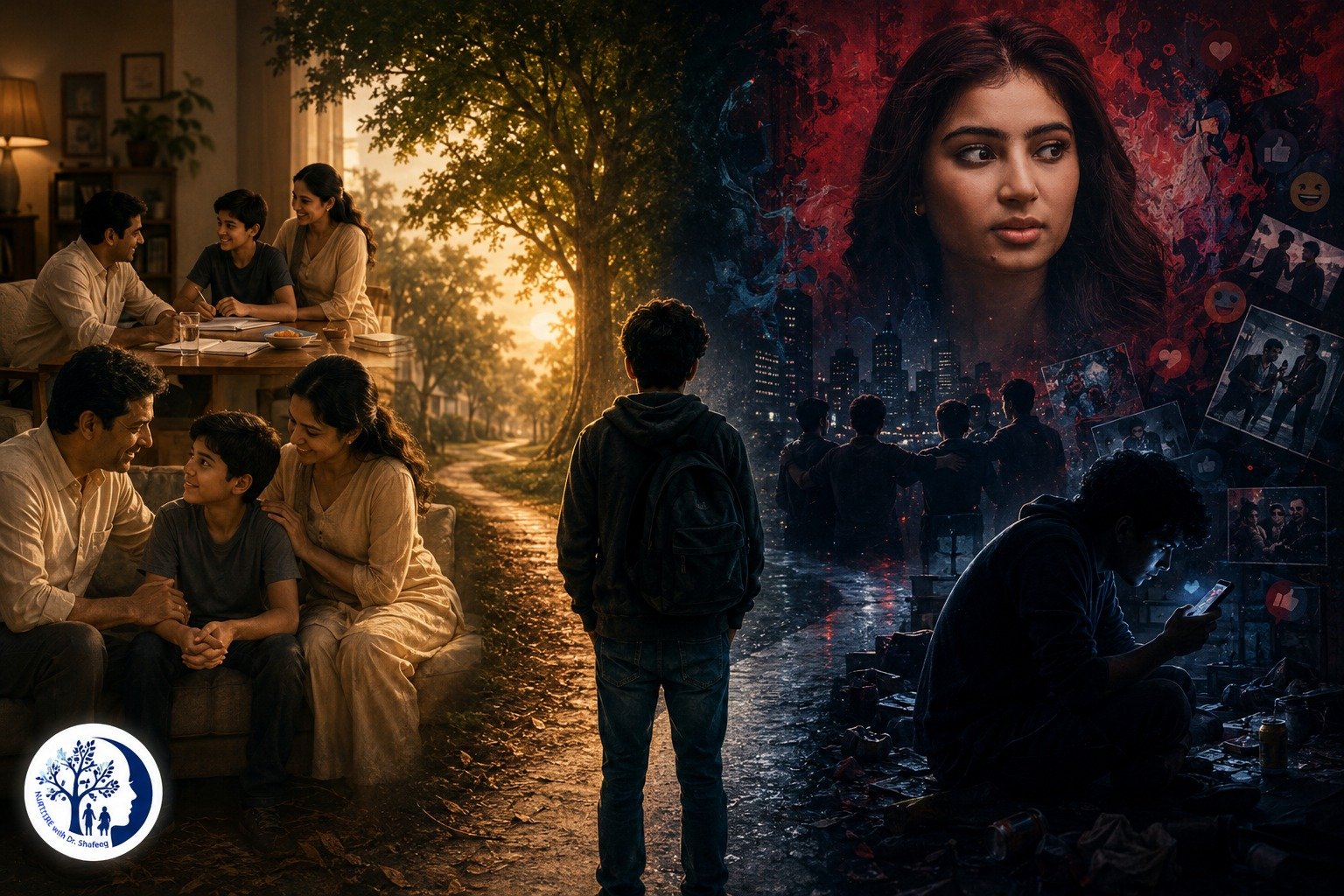
The film's director has spoken about the concern that sits underneath all of this: that children now live, quite literally, in a parallel world accessible through a screen, one that most parents have almost no visibility into. I'd go further. Today's adolescent is simultaneously raised by two entirely separate curricula. One is the family world — parents, school, relatives, the values a household tries to instill deliberately, over years, on purpose. The other is the peer and digital world — friends, social media, pornography, influencers, online communities, distorted templates of what masculinity and status look like, all delivered instantly and privately, often through a device sitting a few feet from where the family is having dinner.
A parent can be deeply attentive to the first world and have almost no idea what's happening in the second. That gap, more than any single bad decision, is where I think a great deal of the damage in stories like this one actually gets done. It's the entire argument of Two Worlds, One Childhood, and watching a film built around exactly that blind spot only confirms why I felt it was worth writing a whole book about.
Raising Boys, Not Just Protecting Girls
The young men in Euphoria don't read as simply "bad boys." They represent a particular, learnable idea of masculinity — one built from power, sexual entitlement, peer approval, risk-taking, and an absence of empathy. A boy can absorb, from his environment rather than from any single conversation, that being sexually aggressive reads as confidence, that ignoring a boundary reads as being desired, that humiliating someone reads as status. If his peer group rewards that template, whatever values his parents tried to instill at home start to lose their grip.
This is why I think raising boys deserves every bit as much deliberate attention as we currently give to teaching girls how to stay safe. Teaching a daughter vigilance is necessary, but it places the entire burden of prevention on the potential victim. Teaching a son consent, empathy, emotional regulation, and the ability to hear the word no without experiencing it as an attack — that's the preventive work, and it happens years before any crisis, in ordinary conversations most parents never think to have because nothing has gone wrong yet.
A Harder Question the Film Also Asks
To its credit, the film doesn't stop at the crime and the punishment. It asks what happens afterward — whether someone who has done something appalling can change, and whether society has any obligation to let that change happen. It's a genuinely difficult question, and I don't think the honest answer is comfortable in either direction. Rehabilitation, forgiveness, and restoring a relationship with the person who was harmed are three separate things, and the film is careful, especially by bringing Chaitra back into the story near the end, not to let the perpetrator's growth quietly stand in for the victim's healing. Justice has to protect the person who was harmed. Rehabilitation, where it's genuinely possible, has to be allowed to transform the person who caused the harm. Neither one gets to erase the other.
What I'd Actually Ask Parents to Take From This
I wouldn't recommend Euphoria simply as a film. I'd recommend it as something to watch with your partner and talk about afterward, honestly, without either of you needing to be right. Whether you actually know your child's friends. Whether you have any real sense of what they watch online, not the sanitized version they'd tell you if asked directly. Whether your child can bring you something about sex, drugs, or peer pressure without bracing for punishment first. Whether you've been quietly giving money in place of time and calling it care. Whether your child, son or daughter, understands consent as something more than a word from a school workshop. Whether your household models, consistently, the behavior it claims to expect. And the question I'd put right at the center of it — when your child does something wrong, do you teach them to sit with the consequence, or do you use whatever influence you have to make the consequence disappear.
That last one is, I think, the real heart of the film. A child doesn't become morally responsible the moment they commit an act. Character is built for years before that moment ever arrives — in a thousand small decisions about presence, boundaries, and honesty that most parents make without realizing how much weight they're carrying. Euphoria is, on the surface, a story about a crime. Underneath, like most of the stories worth paying attention to, it's a story about everything that happened at home long before it.
— Dr. Shafeeq Ahmed
www.drshafeeq.com

Dr. Shafeeq Ahmed S.M
Pediatrician, child psychologist, parenting coach, and career & life counsellor with over 20 years of experience. Read full bio →