Why Marriages Cool Down — and What Actually Warms Them Back Up
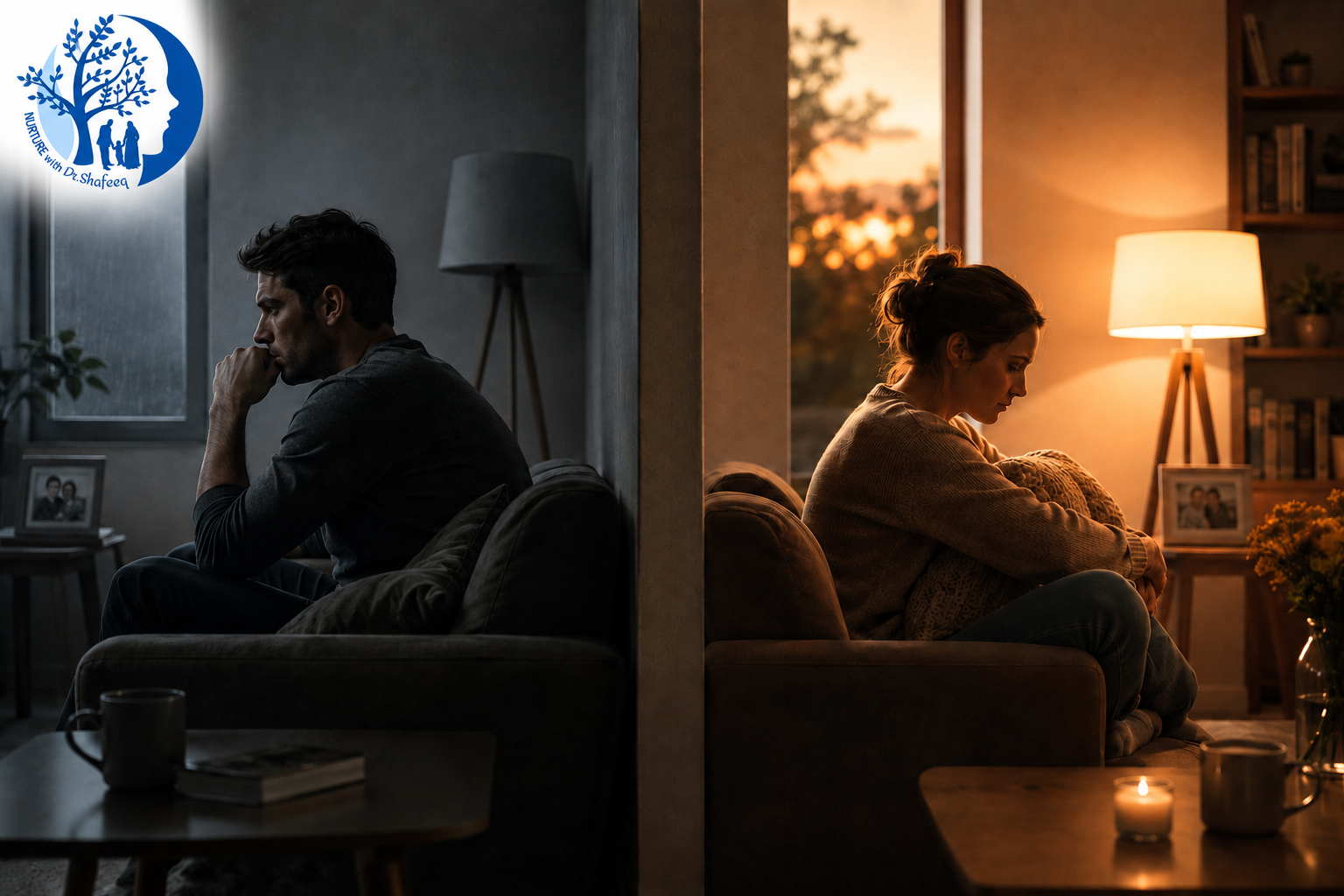
Why Marriages Cool Down — and What Actually Warms Them Back Up
Dr. Shafeeq Ahmed
Every couple I have sat with in over two decades of practice has, at some point, asked me a version of the same question. Not "why did this happen," but "when did this happen." When did we stop reaching for each other. When did the silence at dinner start to feel normal? When did we become two people who run a household well and know each other hardly at all.
I never have a date for them. Because there rarely is one.
We like to imagine that marriages end the way they begin — with a moment. A single fight, a single betrayal, a single decision one partner makes and the other cannot forgive. It makes for a cleaner story. But in the room, across the table, what I actually see is almost never a moment. It is a season. Sometimes several seasons, stacked quietly on top of each other until neither partner can point to the one that mattered.
Falling in love asks almost nothing of us. It is, if anything, the easiest thing two people will ever do together — unplanned, often unearned, carried along by chemistry and timing and the simple relief of being chosen. Staying in love is a different order of task entirely. It is not a feeling you fall into a second time. It is a decision you keep making, on the ordinary days when nobody is watching and nothing dramatic is at stake.
So what actually happens in between?
It is rarely one wound. As I put it in Marriage Beyond Romance, falling out of love, or no longer finding companionship in your spouse, is not a sudden turnaround — it is a gradual process involving loss of trust, a divergence of dreams and life goals, a spiralling descent into negative appraisal of the spouse, a marked and consistent reduction of intimacy in the relationship, a lack of tolerance for perceived flaws, and increasing contempt for the other, while old grudges are nursed until they ferment into festering resentments.
Read that list slowly and you'll notice none of it is dramatic on its own. A little less trust this month. A little more criticism than appreciation this year. A grudge quietly filed away instead of resolved. Contempt, underneath much of it — the quiet, corrosive sense that you are above your partner rather than beside them. None of these are a single event you could point to and say, there, that's when it started. That's exactly what makes them so easy to miss until they've already taken hold.
A marriage rarely announces that it is in trouble. It just gets a little quieter, a little more efficient, a little more like a well-run partnership between two people who used to be in love.
Here is the part I want every couple I work with to hear clearly: this is not proof that you married the wrong person, and it is not evidence that love was a lie to begin with. It is simply what happens to any relationship left to run on autopilot. Falling in love was never going to be enough to keep it — nothing was ever designed to sustain itself without tending. Staying in love is closer to a discipline than a feeling. It asks for patience on days that don't deserve it, forbearance for the version of your partner that shows up tired and short-tempered, a willingness to overlook what could easily be held against them, and the plain, unglamorous act of choosing your spouse again on a random Tuesday when nothing about the moment is asking you to.
That distinction — between the marriage that happens to you and the marriage you build on purpose — is the entire reason I wrote Marriage Beyond Romance: Understanding Marriage Through Human Goods Theory. Most of what we're handed about marriage, culturally, treats it as a feeling to be managed: keep the spark alive, don't let the romance fade, chase the chemistry back if it goes quiet. I wanted to offer couples something sturdier than that — a way of understanding marriage not as a mood to be maintained, but as a shared life built around real, durable goods two people commit to creating together, long after the mood of falling in love has done its work and moved on. It's the book I wish every couple I've counselled had read before the quiet started, not after.
It sits alongside two other books that, looking back, have really all been asking one underlying question from different angles: what does it take to actually see the person in front of you, and stay close to them, once the easy part is over.
The Relationship Iceberg: Understanding People Beyond Their Words grew out of the same observation that shapes my counselling work every day — that the words two people exchange are the smallest, most visible part of what's actually happening between them. Beneath every conversation sits tone, emotion, intention, and unspoken belief, and most conflict, marital or otherwise, is really a collision between what's below the surface on both sides, mistaken for a disagreement about what's above it.
And because none of this — the marriages, the miscommunication, the slow drift — happens in isolation from the children growing up inside these homes, my most recent book, Two Worlds, One Childhood: Raising Kids Who Can Thrive Online and Off, turns the same attention toward parenting in a childhood no earlier generation had to raise one through: a child living in two worlds at once, the physical one we grew up in and the digital one that now runs alongside it from almost the beginning.
If any of this sounds like your own marriage, or a season you can already feel arriving, I'd say the same thing to you that I say across the table in my practice: noticing it this early is not a bad sign. It's the only real chance you get to do something about it before the quiet becomes permanent.
— Dr. Shafeeq Ahmed
www.drshafeeq.com
Dr. Shafeeq Ahmed S.M
Pediatrician, child psychologist, parenting coach, and career & life counsellor with over 20 years of experience. Read full bio →