The Glitz, the Glamour, and the Silent Scars: Safeguarding Children in the Spotlight
The Glitz, the Glamour, and the Silent Scars: Safeguarding Children in the Spotlight
Dr. Shafeeq Ahmed
A few days ago, a name that many of us grew up watching on screen made headlines again — not for a new film, but for something far more difficult. A well-known child artist, someone who appeared in hundreds of films and whose face many of us recognize from his years playing a young Amitabh Bachchan, spoke publicly for the first time about sexual abuse he experienced during his childhood years in the industry, and the therapy it eventually took him to process it. I am not going to use his name here, because this piece isn't about one man's story. It's about every child standing under those lights right now, and every parent standing just outside the frame, trusting that the people around their child have their best interests at heart.
I have spent years sitting across from children and families as a pediatrician and child psychologist, and one thing I can tell you with certainty is this: disclosures like the one that made news recently are never really about the past. They are about a child, decades ago, who did not have the words, the safety, or the permission to say what was happening to them. The story becomes public as an adult's memoir. It began as a child's silence.
The Dark Reality Behind the Curtain
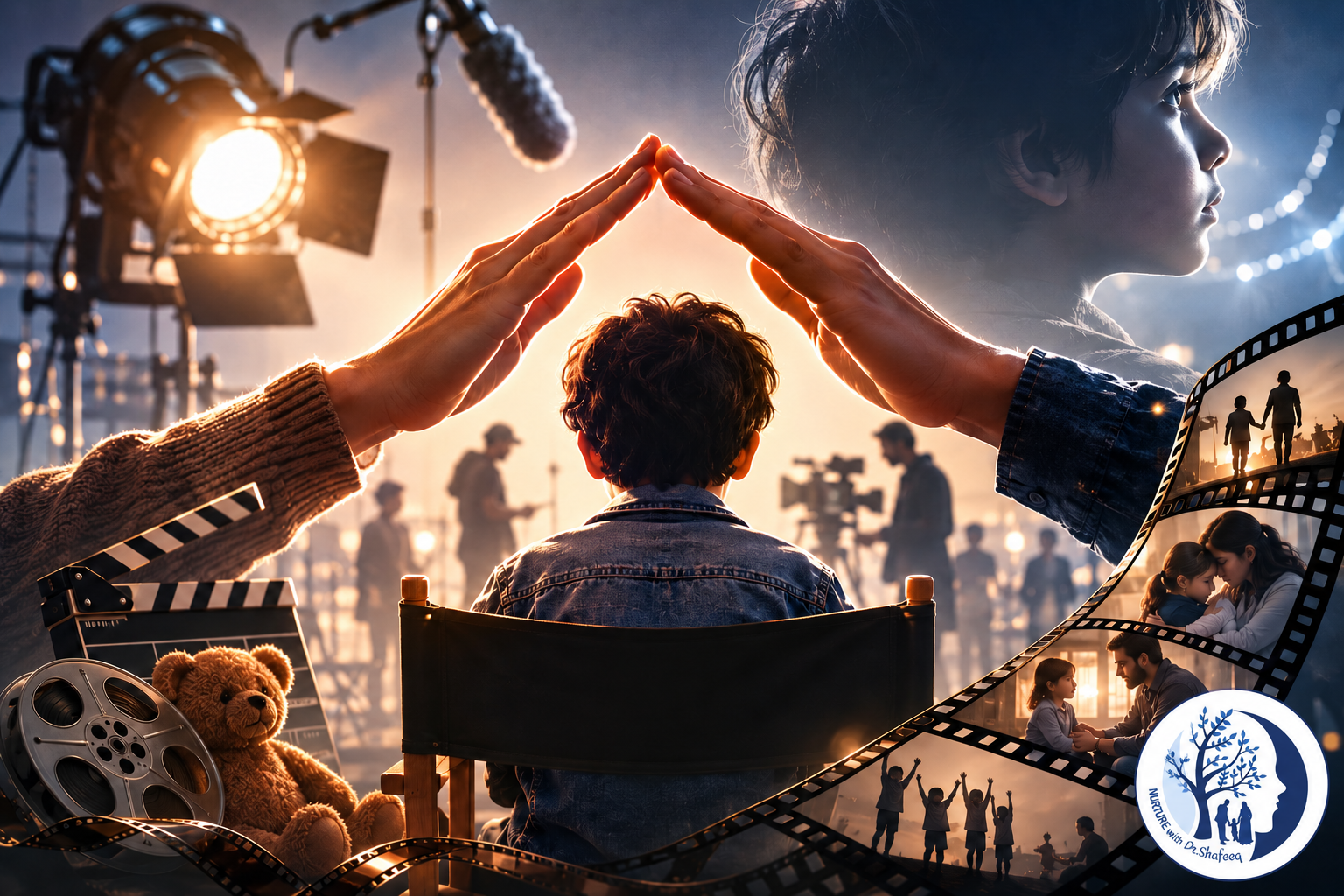
The entertainment industry, for a child, is an unusual environment by any measure. A film set collapses the ordinary boundaries that protect children in everyday life. There are adults everywhere — directors, choreographers, costume and makeup teams, spot boys, coordinators — many of whom have legitimate reasons to be close to a child physically, adjusting a costume, guiding a dance step, applying makeup. That physical closeness, which is routine and necessary in the right hands, is also exactly the kind of access a person with harmful intent can exploit, because nobody around the child would think twice about it.
Add to this the culture of "the show must go on." Productions run on tight schedules and tighter budgets. A child who seems distressed, withdrawn, or reluctant is, more often than anyone would like to admit, coaxed rather than questioned, because the next scene needs to be shot. Parents are frequently not present on set for every hour of shooting, sometimes by necessity, sometimes because they are told their presence isn't needed for a particular sequence. And many child actors, especially those from families depending on that income, carry an unspoken pressure to be easy, agreeable, uncomplaining — the "good child artist" who doesn't cause problems. That pressure alone can be enough to keep a child from ever telling anyone that something felt wrong.
None of this requires a villain in every corner. It only requires ordinary adult inattention, a culture that prioritizes output over welfare, and a child who has learned, quite reasonably, that their comfort is not the priority in that room.
The Psychological Toll of Silence
What struck me most about this recent disclosure was not the abuse itself, but the years between the experience and the telling of it. This is, unfortunately, the rule rather than the exception. Most children who experience sexual abuse do not disclose it at the time, and many do not disclose it for years, sometimes decades. As a clinician, I want parents to understand why, because the "why" changes how we respond.
Children rarely have the language to describe what has happened to them, especially when the person involved is someone with authority, someone their parents trust, or someone who has been kind to them in other ways. Confusion is common — a child can feel that something is wrong and still not know it has a name. Shame attaches itself early, often before the child even understands what they are ashamed of, and it tends to whisper the same message across cultures and decades: this was somehow your fault, and telling will make things worse. Many children fear they won't be believed, particularly if the person involved is well-regarded by the adults around them. And some children, especially those whose family's livelihood depends on their continuing to work, sense — without anyone ever saying it outright — that a disclosure could cost the family something, and they carry that weight silently to protect the people they love.
The long-term toll of this silence is real and well documented in the clinical literature. It can show up as anxiety that seems to come from nowhere, a fear of specific places or situations that no one else connects to the original event, difficulty trusting authority figures, struggles with intimacy in adulthood, or a persistent, low-grade sense of never quite being safe. A child can look, by every outward measure, successful and fine — working steadily, achieving, smiling in photographs — while carrying an entirely different internal reality. Outward success is never proof that a child is unharmed. It is often simply proof that the child learned to perform wellness the same way they learned to perform on camera.
Actionable Steps for Parents
If your child is in front of a camera, on a stage, in competitive sport, or in any setting where adults outside your family have regular access to them, here is what I would ask you to build into your family's ordinary practice, not as a one-time conversation but as a running culture at home.
Teach body autonomy early and repeat it often. Every child should grow up knowing, in simple and concrete language appropriate to their age, that their body belongs to them, that no adult gets to touch them in ways that make them uncomfortable regardless of who that adult is, and that they will never be in trouble for saying no or for telling you afterward, even if someone told them not to.
Never outsource full supervision, even to people with authority or reputation. A director's title, a coordinator's experience, or an institution's name does not make unsupervised one-on-one time with your child automatically safe. Wherever possible, be physically present, or ensure another trusted adult from your side is present, particularly during costume changes, makeup, rehearsals in closed rooms, and travel.
Ask specific, non-leading questions regularly, not just "did anything bad happen today." Try questions like "was there any moment today you didn't like" or "did any grown-up ask you to keep a secret from me" or "did anyone touch you in a way that felt strange, even if it wasn't painful." Keep your tone curious and calm, not alarmed, so your child doesn't learn to protect you from your own reaction.
Watch for behavioral signals rather than waiting for words. Sudden reluctance to go to a set or practice they previously enjoyed, changes in sleep or appetite, regression in younger children, new fears of specific people or places, or a shift in mood around a particular adult are all worth a quiet, private conversation, not dismissal as "just a phase."
Build a genuine no-punishment culture around telling. If a child sees, even once, that honesty leads to anger, disbelief, or consequence, they file that lesson away and use it to justify staying silent the next time something matters far more.
Vet the environment, not just the opportunity. Before saying yes to a role, a coach, or a mentor, ask direct questions about chaperone policies, who has access to your child and when, whether background checks exist for crew and staff, and whether there is any child protection protocol on record. A hesitant or vague answer is itself useful information.
The Broader Role Industry and Society Must Play
Parents cannot carry this responsibility alone, and it would be unfair to suggest otherwise. The entertainment industry, sporting academies, and any institution that regularly works with children owe those children structural protection, not goodwill. That means mandatory, verified background checks for anyone with access to child performers. It means trained child safeguarding officers present on sets, not as a compliance formality but as a functioning role with real authority to pause production when a child's welfare is in question. It means clear, enforced policies on chaperones and one-on-one contact, and consequences that are actually applied when those policies are violated.
It also means something less procedural and more cultural: we, as a society, need to get better at receiving disclosures like the one that prompted this piece. When a survivor speaks, years or decades later, the response that matters is belief, not disbelief dressed up as skepticism about timing. Every time a disclosure is met with genuine support rather than doubt, it becomes a little easier for the next survivor, and the one after that, to find their voice sooner.
I write often, across my books, about the gap between what a family looks like from the outside and what is actually happening beneath the surface — in a marriage, in a relationship, in a child's inner world. This story is a painful reminder of the same truth in a different setting: glamour, achievement, and a full filmography can sit directly on top of a child who is silently struggling, and nobody around them may know until years later. Whether it is a marriage quietly cooling in "Marriage Beyond Romance," the hidden weight beneath a relationship's surface in "The Relationship Iceberg," or a child trying to navigate the pressures of visibility — on a film set or on a screen — in "Two Worlds, One Childhood," the work is the same. Look beneath the surface. Ask the harder question. Stay close enough, and safe enough, that a child never has to carry something like this alone.
If this piece raises anything difficult for you personally, please know that support is available, and reaching out for it is a sign of strength, not weakness.
— Dr. Shafeeq Ahmed
www.drshafeeq.com

Dr. Shafeeq Ahmed S.M
Pediatrician, child psychologist, parenting coach, and career & life counsellor with over 20 years of experience. Read full bio →