We Teach Children Not to Fear the Dark. Who Teaches Us Not to Fear the Truth?
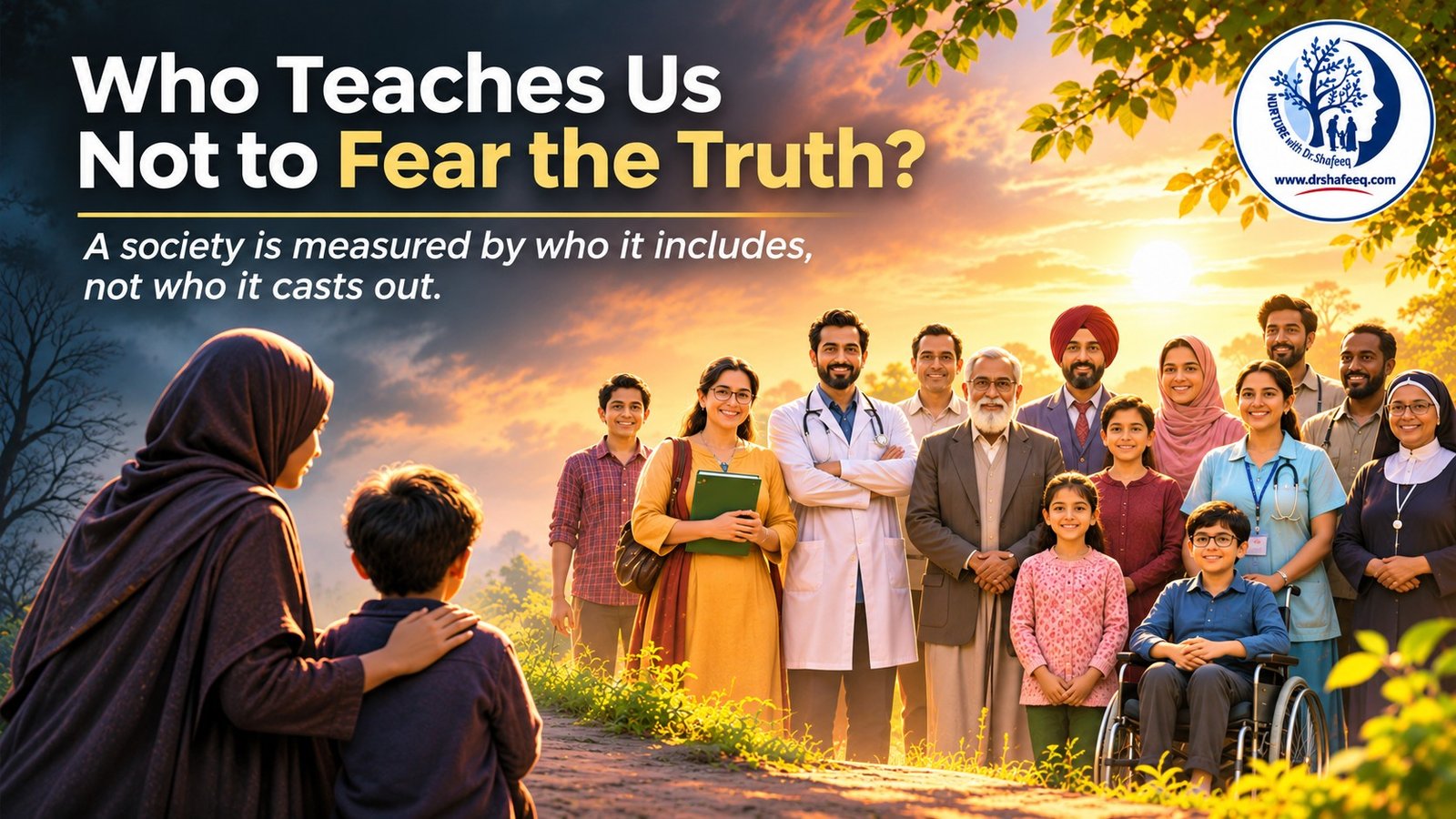
We Teach Children Not to Fear the Dark. Who Teaches Us Not to Fear the Truth?
On civic courage, the danger of narrow nationalisms, and why real strength lies in facing our flaws.
By Dr. Shafeeq Ahmed
When a child wakes from a nightmare, crying because shadows stretch across the bedroom wall, our response is instinctive. We turn on the lamp. We sit at the bedside and say, “Look around. There is nothing to hide from. The room is safe.”
We spend years teaching our children not to fear the dark—not to run from the unknown, not to let shadows dictate their actions, and to have faith in the morning.
Yet as societies, we often succumb to a much more dangerous anxiety: the fear of the light.
We become terrified of the truth when it challenges our preferred self-image, when it reveals that our comfort has rested on another’s struggle, or when it requires us to share space with someone who looks, prays, or speaks differently from us.
When fear takes the wheel, political discourse invariably shrinks. It retreats into exclusion, tribalism, and what historians recognize as the oldest rhetorical trap of all: defining a nation not by its shared moral ideals, but by ancestry, bloodlines, and artificial scarcity.
1. Belonging Is Defined by Convictions, Not Ancestry
In a widely shared address in Atlanta, U.S. Senator Jon Ossoff laid out a fundamental distinction that resonates far beyond American borders:
Americans are not a race. We’re a people, united not by ethnicity, but by shared convictions.
The speech traced an expansive historical arc. A nation’s heritage cannot be reduced to a single founding group or dominant ethnicity. It belongs equally to indigenous communities who walked the land for centuries, the descendants of the enslaved who fought for liberation against state-sanctioned injustice, and every immigrant who arrived fleeing persecution or seeking opportunity.
He cited George Washington’s 1783 declaration that a free republic must be open to receive:
Not only the opulent and respectable stranger, but the oppressed and persecuted of all nations and religions.
This is not merely historical trivia; it is a universal civic truth. Whether in the United States, India, or anywhere across the globe, whenever a culture begins to equate "true citizenship" with a single racial, religious, or ethnic identity, it abandons the moral foundation of a pluralistic society. Pluralism does not dilute a society; it fulfills it.
2. Real Patriotism Confronts Uncomfortable Realities
It is easy to celebrate technological milestones, military dominance, and economic wealth. It is much harder—and requires genuine civic courage—to look in the mirror at human suffering.
As the address pointed out with striking candor, even within the wealthiest nations, systemic contradictions persist:
Why should a rich society accept shorter life expectancies, persistent child poverty, or elevated maternal mortality rates?
Why should economic abundance coexist with acute social vulnerability?
A mature society does not label honest inquiry as “unpatriotic.” Patriotism is not unquestioning praise of the status quo. True patriotism is the willingness to confront deep-seated disparities in public health, education, and justice, precisely because you care enough about your community to see it healed.
If we hide from these facts, we are like adults running from the lamp.
3. How We Measure the Success of a Society
Perhaps the most compelling moral argument in the speech is its definition of civic progress:
The true measure of a society’s success is not how many of the vulnerable it can hunt down, silence, or cast out. The measure of success is whether each generation achieves greater health, equity, and prosperity than the last—and whether we live up to the promise of equal justice for all.
When leadership builds its authority on scapegoating minorities, blaming immigrants, or weaponizing cynicism, it offers a small, claustrophobic vision of the future. It treats human dignity as a zero-sum game, convincing citizens that for one family to flourish, another must be excluded.
True leadership does the exact opposite. It expands the circle of empathy. It insists that improving neonatal care, protecting the impoverished, and building ethical governance are the genuine benchmarks of national greatness.
Choosing the Light
Democracy and civic peace are not self-sustaining machines. They do not run on autopilot. They depend on ordinary citizens deciding every day whether they will be governed by fear or by principle.
We teach our children that the shadows cannot harm them if they have the courage to turn on the light.
It is time we demand the same courage from ourselves:
The courage to welcome the diverse threads that form our communities.
The courage to demand that public health, child welfare, and justice take precedence over tribal grievances.
And the courage to admit where our systems have failed, so that we may finally begin the work of repairing them.
We have mastered calming our children’s fears of the dark. Now let us prove that we are no longer afraid of the light.
Key Takeaway :
We spend years teaching our children not to fear the dark. But when will we find the courage not to fear the truth? A society is not measured by who it excludes, but by how courageously it protects the vulnerable, honors pluralism, and pursues justice for all.
#NurtureWithDrShafeeq
Dr. Shafeeq Ahmed S.M
Pediatrician, child psychologist, parenting coach, and career & life counsellor with over 20 years of experience. Read full bio →